
A phishing email in Irish, pretending to come from Julie Leach, a 2015 US lottery winner and claiming it’s giving $500,000 to a few lucky individuals will only enrich scammers if you fall for it.
In 2015 Julie Leach, a Michigan fiberglass factory employee, was visited by Lady Luck and won $310 million in Powerball lottery. Since then a whole series of spam emails have been circulating, using her story as bait, to scam victims into giving up various things they shouldn’t, from logins and credit card details, to direct acces to their computers.
In Ireland, we’re also sometimes treated to extra effort by scammers, who go out of their way to pop the usual scam email into Google Translate and offer us an Irish version. At ESET Ireland we take particular interest in this sort of effort and we’ve written about it before here, here, here, here, etc.
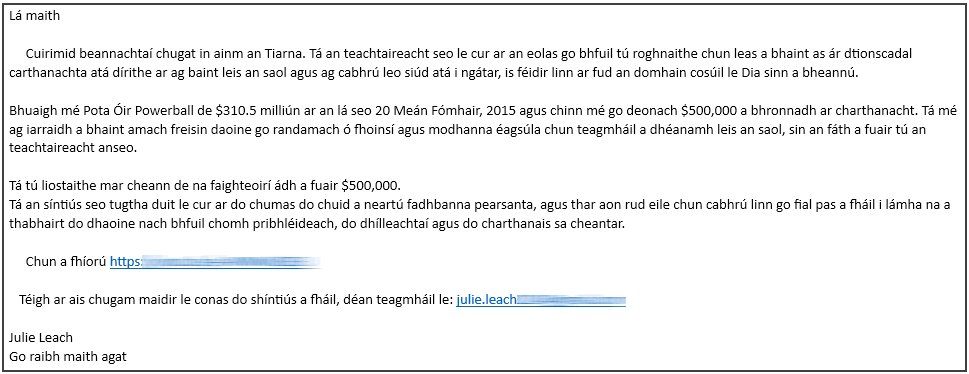
This time, the email claims “that you have been chosen to benefit from our charity project which is aimed at touching life and helping those in need” and that you “are listed as one of the lucky recipients of $500,000” and that “this donation has been given to you to enable you to strengthen your personal problems, and above all to help us generously pass into the hands of those who give to less privileged people, to orphans and to charities in the area”. So kind of them. At the end is an email address (different from the one the spam email was sent from), and on the other side of it is a scammer waiting to hear back from people who fall for it.
If they do receive a response, these phishing scams often entail asking the victim to first settle various advance payments, transfer costs, solicitor fees and other made up expenses, before they can receive their “prize”, which of course, they never do. At other times they send various “confirmation” emails, which ask you to “log in” to anything from Google to an online bank, therefore providing the scammers with victims’ log in details.
Most people no longer fall for most of these, but some still do, or the scammers would have long given up on sending them. For them it’s a numbers game and statistically they still count on a certain number of potential victims biting the bait. ESET Ireland offers a few tips for staying safe:
- 10 signs that scammers have you in their sights
- Getting off the hook: 10 steps to take after clicking on a phishing link
- What are some common subject lines in phishing emails?
by Urban Schrott, ESET Ireland
 ESET Ireland